You’re late. And what are you going to do about it?
Several years ago I found myself at school late on a Friday night. I was loosely supervising Jill and India Carson, awaiting the arrival of their mother - the last parent to come and pick up the last two students in Friday Night School.
Friday Night School is an intermediary consequence for students whose misbehavior might otherwise be cause for suspension from school. Instead of being suspended or otherwise removed from class, they stay with me on Friday night. Middle school students stay an hour and a half, high schoolers two and a half hours. FNS ends at 6:30. It was 7:30, and the older sister had just called their mom again to confirm that she really was on her way. She said she was “leaving now.”
I was only mildly hopeful. She was, after all, already an hour late, and we had earlier received the exact same reassurance. They lived roughly 10 minutes from school.
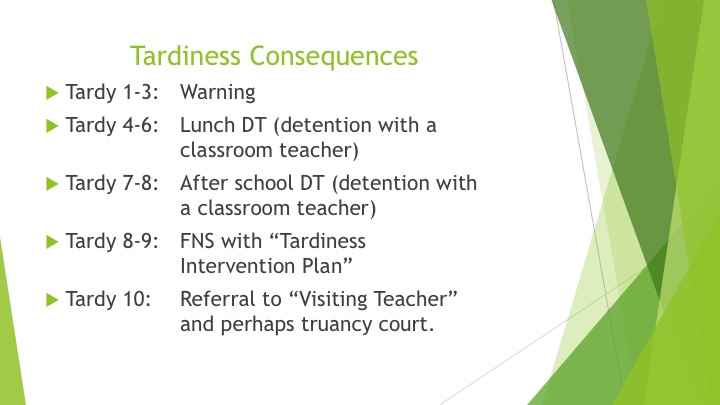
It happens that these sisters had received FNS because of tardiness. Chronic, repeated, and extended tardiness. At the time, we had a system of interventions in place. It worked something like this:
Each quarter we “re-set” the system, and students were understood to again have zero tardies, and they started up the discipline ladder all over again.
-previously posted January 18, 2016 by Jack M. Jose
In reflection, there are many things that are unusual about this scene: The morning of the first day of our annual fall staff retreat, I was seated cross-legged on the floor in front of my staff, presenting the Gamble Great Lesson, and I was crying.
I would like to claim I never cry at work. It is, at least, unusual.
I wasn’t alone. Others were crying too. Crying partially because that next to last part of our story is exceptionally sad; the untimely death of two students in the same year deeply affected our school. Crying also because we needed to. In the moment of our most intense sorrow, or the series of endless moments of dealing with grieving students and parents, there simply had not been time to cry. And this time - the crying together - illustrated precisely why we need to tell the Gamble story over and over again, as it changes and grows.
Embedded deep in the Montessori philosophy, including student-directed learning , the Socratic method of questioning and the Adlerian concept of seminar, is an understanding that humans are naturally drawn to explore life’s great mysteries. We want to know the origins of the universe, the origins of life and human beings, how we started to communicate, and the origins of math. In these Montessori great lessons are the roots of the academic disciplines of science, history, reading and writing, and math. And those five stories already exist and are overtly taught to students as part of Montessori elementary philosophy.
Adolescents deeply feel the need to belong and they have a yearning for deep connection. So just as there is a great lesson for each discipline, it is appropriate to create a story to help students (and staff) understand that they are part of something larger - in this case, a school with a short but powerful history. This was the genesis of the Gamble Great Lesson: if students and staff can understand why the school exists and our core values, and will accept our invitation to belong and make their mark in the school, everyone benefits. When a person feels deep connection to a place or an idea, when they feel they belong, it is a sort of magic. It is the basis of grit, and hard work, and victory … and vulnerability. It makes it safe to try, and safe to fail, and even safe to not fight.
Teachers training to lead the JumpStart Theatre program.
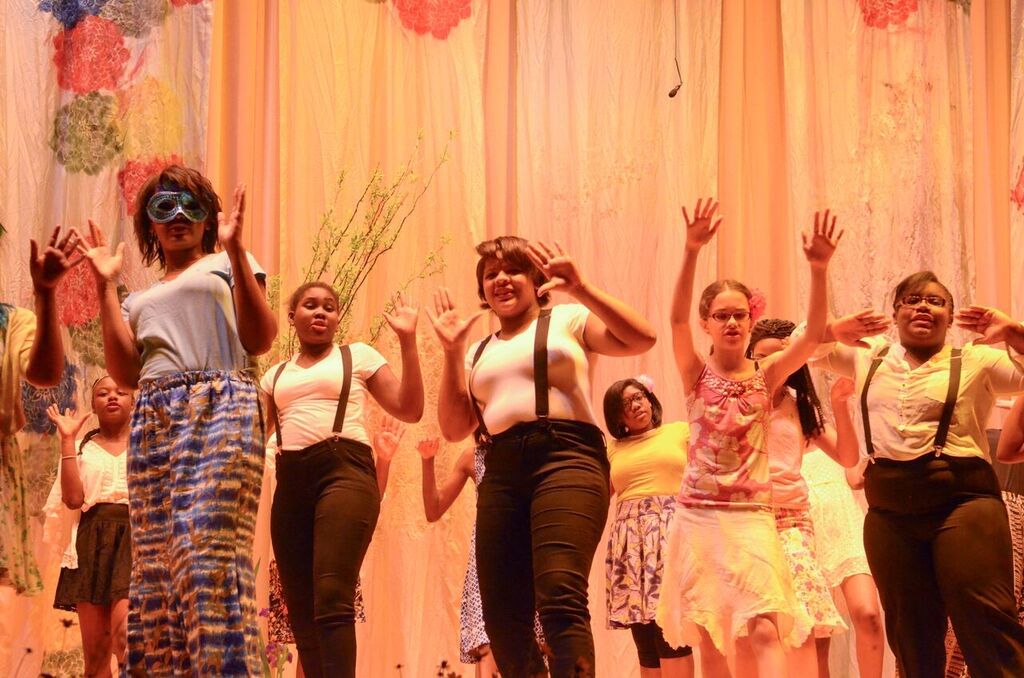
In the 2015-16 school year, Gamble Montessori earned a chance to participate in a groundbreaking new theatre program through a competitive application process. The Educational Theatre Association (EdTA), a large national actors’ guild, had initiated a program called JumpStart. Designed to help schools develop drama and theater programs, JumpStart targets schools that have no drama program. They provide training for teachers, access to modified musical scores which are tagged with the label “Jr.” (e.g. Once on This Island, Jr., or Annie, Jr.), and a structure for staging your own middle school musical in the spring.
In order to be selected for JumpStart, the school must first verify their dedication and determination to establishing an ongoing drama program. This is determined through interviews, where our responses to a series of questions were investigated to make sure we had the resources and initiative to accomplish the work. Once a school was selected – Gamble was one of three in this inaugural round – JumpStart provided support throughout the process.
Following the successful staging of Once On This Island, Jr. at Gamble Montessori in the spring of 2016, I was asked to speak at a fundraising breakfast to a group of EdTA donors. Other speakers from EdTA spoke about how the program came about, and between each set of speakers a professionally produced video was shown. Each video featured snippets (like this one) from the training or the performances, and interviews with those involved, myself included. Below are my remarks, edited for clarity.
Josh Vogt stepped into my office and handed me a calendar. “Umm, thank you,” I offered.
“October,” was his only instruction. I examined the annual Day by Day calendar published by the Greater Cincinnati Coalition for the Homeless. As instructed, I turned to October, expecting to see a photograph of our students. Instead I saw a picture of a group of people I did not recognize, taken downtown near a local homeless shelter. “Bella.” I looked closer but did not see the student he named, and I looked up at him.
“Bella TOOK this picture. This is her picture, from the Mayerson experience this summer.”
The evident pride on his face was well-earned. Josh has worked diligently with students in our school to help them become aware of the social and economic factors that contribute to poverty in our community. For four years he has led a Peace and Justice intersession at Gamble Montessori which includes an overnight “shantytown” experience, where students construct a cardboard shelter and sleep in it overnight on our school grounds. He had, most recently, given up a summer week, 11 hours a day, to partner with our students, the Mayerson Foundation, and Cincinnatians experiencing homelessness. The goal was to humanize the problem, and help students understand the difficulties faced by the poorest of the poor. But what he wanted was this – not to have students merely become aware of the problem, but to have them be part of the effort to fix it. Bella was contributing meaningfully to the conversation.
Students sort materials at a local service organization.
For a generation, students in high schools have been doing community service in increasingly formal programs. Nearly every high school in the Cincinnati area has a community service requirement that centers around accumulating a certain number of service hours over a high school career. The Mayerson Foundation, which generates and implements “innovative approaches to important issues” in Cincinnati, has helped promote a culture of community service in more than 30 high schools and districts around the greater Cincinnati area, and is a leader in structuring programs designed to promote community service and related service learning. Nationwide, about a quarter of our population participates in meaningful community service annually, though there has been a slight decline since 2011.[1]
Community service, can be broadly defined. In school, often it is a teacher who sets up an opportunity for individual students or an entire class to participate in an activity designed to help a person or organization. This can take many different forms. Gamble students have planted butterfly gardens and removed invasive plants, they have repaired fences to keep out predators and spent time with traumatized animals to prepare them to live with a new owner, and they have worked with toddlers and the elderly.
This passion for involving students in giving of their time and talents to others is beneficial. The community gains an energetic and impressionable army of workers, who often drag friends and family into the work. Students gain a sense of accomplishment and begin to see the scope of the work of adulthood, and the real problems faced not just in other countries but by those in their own backyard. It develops a sense of self-efficacy in the student, who can see themselves as a helper instead of someone who needs the help of others. It fosters grace and courtesy, as we teach lessons about the environment, the elderly, and people experiencing homelessness, and students become comfortable with manners in a variety of new circumstances.
Additionally, developing a habit of volunteering can actually lengthen one’s life, as older folks who volunteer regularly are shown to live longer than those who do not, when controlling for other factors[2]. Finally, we know that adolescents crave meaningful work while resisting busy-work, and tangibly helping a person or an agency as part of a larger cause helps satisfy this urge to make a real impact in their own community.
So volunteering is good. How do we get students to buy in?
Until now, the answer has been: make them do it.
Gamble Montessori looked at other schools’ requirements and settled on an average number of hours from neighboring schools. High school students were asked to compete 50 hours of service a year, for a total of 200 hours required for graduation. Middle school students had a slightly reduced requirement of 30 hours each year.
From the beginning, student involvement in our community service requirement was uneven. Only a few of our students, born into families with strong community service ethics and the means to support this passion, met the requirement each year. Others struggled to make the required total, and sought flexibility in the rules of what we would call service. Teachers found themselves broadening the definition of service. Soon the student lists included raking leaves for grandparents, to dishwashing at home, and we even accepted spending time at home with siblings while parents were at work as community service. Other students failed to meet even this newly broadened standard, and we found ourselves in the position of asking if we were passionate enough about our commitment to service that we would prevent a student from graduating if the requirement was not met. We answered by quietly ignoring the requirement.
The odds seemed stacked against getting all of our students to meet this expectation.
The hours and evidence were hard to track at high school. We tried monitoring it through our advisory, but with infrequent meetings in a class where we typically did not keep grades, the tracking was uneven and unreliable. There was also the issue of keeping and verifying evidence. It was suggested that we centralize it and the task was assigned to one teacher assistant at the school. This seemed to be working until the paper records were entirely lost in a building move. Finally, with the help of a counselor – available through use of a temporary grant – we purchased a program for helping the students track their own hours online. After about a year of implementation, we had trained most of our students in the program, but found that the additional step of self-recording appeared to have diminished our community service participation.
Frustratingly, we also had to confront the reality that some of our students were among those who benefited from charitable giving in the Cincinnati area. More than 70% of Gamble Montessori students are living in poverty, as measured by their eligibility for free or reduced price lunch. Several of our students qualify for assistance under the McKinney-Vento act, designed for students who have experienced homelessness.
This showed up several years ago, when teacher Gloria Lane was working with students to identify a place where they wanted to do some service. One of our 8th graders reported to his teacher that he wanted to work at a particular church that was far from his home. When she asked why he would choose a site that would be hard to get to, she told me that he shared with the class, “They brought presents to my little brother last year. They were really nice.” We explored the irony, or perhaps it was something worse than mere irony, of asking students living in poverty to give their time and resources to helping others. While the spirit of giving was strong (it is my observation that often our poorest families are the quickest to give and the most generous), it felt unfair to make the same demand on our neediest families.
The final nail in the coffin came through the observation made off-hand by a staff member, perhaps Josh himself, at a meeting where the service requirement was being discussed. “It’s another step in the school to prison pipeline. We’re making them do community service hours to get out.”
Ugh.
Sure enough, the perception among some members of our society is that community service is assigned in response to committing misdemeanors. Service as a consequence is so pervasive in our society that local United Way agencies maintain a list of agencies that provide opportunities for people needing to complete court-ordered community service. So our requirement, instead of creating an internal desire to do service for others, was instead inadvertently associating school with crime and punishment in the minds of some of our students. This could reasonably be seen as a powerful motive for some of our students to resist the requirement.
Still, we knew that the act of service is important for students and the community, and we sought to find the right program to build this habit. We had been trying to provide technical solutions to a larger, cultural (or adaptive) problem. We needed a revolution.
Students work to prepare a celebration and exhibition of the work of local visionaries and voices.
Recently, through our partnership with Clare Blankemeyer of the Mayerson Foundation, Gamble teacher Josh Vogt took a revolutionary new approach to service at the school level and created a program he called “Gators Give Back.” While we still have some of the same tracking and participation issues – technical problems that we hope can be resolved – it is a brilliant answer to the larger, adaptive problem of addressing the desire to participate by creating a real relationship between the student and the work.
In Gators Give Back, the hours and hours of potentially disconnected service, possibly spent at dozens of agencies addressing a range of problems, or raking leaves and babysitting, are replaced by a single focus area chosen by the individual student.
The difference between the old program and Gators Give Back is stark, evident right from the first service activity through the finalization of their senior project. At each high school grade, the requirement is distinct from the old “counting 50 hours” expectation.
Ninth graders, instead of being asked to provide evidence of 50 hours of service, select one opportunity from a list provided by the Gators Give Back committee. They are encouraged to attend with a classmate. Then, responding to a prompt, they write a reflection on the experience, which they share with their classmates.
Tenth graders are asked to dig a little bit deeper. Again encouraged to do this in a group of two or three, they must attend the same agency two or three times, gaining an awareness of the social impact and importance of a particular topic. This time, instead of writing a personal reflection, students are asked to take on the role of advocate. In a letter to a public official, they are to explain what they have learned about their chosen agency and the need it meets, and then suggest ways the public official could assist in the area of need.
Our close partnership with the visionary Mayerson Foundation is an essential component of the 11th grade requirement, philanthropy. Our juniors take stewardship over $1,500 dollars provided by the Mayerson’s Magnified Giving program, created by local philanthropist Roger Grein. Over the course of the year, they investigate the work of the agencies they already know firsthand, reviewing grant proposals that are written directly to the students from competing agencies, and researching the needs of the agencies and the community. They invite the agencies to bring proposals to the group. Ultimately, using criteria they have devised, they award the $1,500 to a deserving agency in a triumphant end-of-the-year ceremony.
Noticeably absent from these first three years of the program are the reliance on counting hours, and the likelihood of students experiencing a range of different and uneven volunteering experiences. Instead, students in the Gators Give Back program find themselves serving and reflecting and learning about a particular area of concern, while thinking about multiple aspects of the service. Whereas a student in the former program might have spent hours folding clothes donated to a local shelter, a student today gets an experience with a trusted partner like Visionaries and Voices, then explains the problem to someone in a position to help, and steps into the role of the person in a position to help.
The Gators Give Back manual provides a list of possible agencies and areas of need, and provides templates and prompts for the writing, as well as key definitions for terms such as service learning and advocacy.
Students in our program gain a nuanced understanding of the relationship between societal needs, face to face assistance, and the agencies and systems that can either ameliorate or exacerbate the conditions that make the service necessary.
Senior year, the service project becomes more involved, intertwining with senior project in a segment aligned with the Youth for Justice curriculum. The work is far more involved, requiring several components, and deepening the student’s involvement in issues and solutions.
The senior must select a service topic that relates to their year-long project, often with a connection to their intended career or area of study in college. They must seek out a mentor who is knowledgeable in that area, who will guide them in learning about the topic and making suggestions for meaningful action. Then, importantly, students must begin to implement that solution. At this level, we initially had a minimum requirement of hours, as well as a minimum number of contacts with the mentor, but in practice we found that many of our students had so many contacts during the process that tracking them seemed artificial, and the requirement has fallen by the wayside.
Our seniors are responsible for tracking this progress, and for presenting the work as part of their senior project. This step helped address the accountability issue that existed when community service was a standalone hours-counting project. Enmeshed with their senior project, the work becomes more personal, and directly tied to graduation. Senior Project is a non-negotiable for graduation at Gamble.
I attended one successful project, a domestic violence awareness walk organized by Tariah Washington. Replete with catered food and special-order t-shirts bearing her slogan, the walk drew 50 people who marched and carried placards around our school neighborhood before eating and hearing the presentation Tariah prepared.
Jack and friends join a student-created march against domestic violence.
The Gators Give Back program is revolutionary because it tackles the kinds of problems that have been plaguing community service programs in high school since their inception. Students are not providing hours of disconnected service in multiple places. Instead they are building meaningful connections with issues of need in their own community. Now, hopefully, students find that service is inextricably linked to a required graduation component. They cannot hope to duck under the gaze of an individual tracking their hours, as the largest portion of the work is part of senior project. Now: impoverished students who may find themselves served by an agency can see a role for themselves beyond receiving or giving temporary help, instead working in the role of advocate and benefactor. This gives them practical skills that they can use in their own situation to make a sustainable change in their own family’s situation. Now: our program is not aligned with the mandatory, punitive community service programs in the justice system, counting hours until release.
Josh related to me a longer version of Bella’s story.
“Bella is one of those students whose life was literally changed by serving others. I’ll never forget that during the summer program, she was strongly advocating for eliminating spikes on concrete that some businesses put on the ground to discourage people experiencing homelessness from sleeping there. One of the StreetVibes vendors we were working with was actually sticking up for the businesses, but Bella did not back down. Another of the vendors raised his hand and said ‘No, man, I agree with her’ and the other vendors started clapping!”
Through service, advocacy, philanthropy, and mentored service learning, students in the Gators Give Back program transcend typical service. Instead they are empowered to act in an area that is meaningful for them.
As a school we have more come a long way, but there are still improvements we could make. This service paper could be incorporated as requirements in English and social studies classes. The letter they write in 10th grade meets a specific requirement for the ELA standards, and working on this in class for a grade would reinforce the requirement, improve the writing, and provide additional support for the student and the work in the school. Advocacy certainly meets high-level expectations in American History and Government classes.
This is how we are doing service at Gamble.
How can you promote service, advocacy, and philanthropy at your school? What have we missed?
Montessori philosophy uses the “Golden Triangle” to represent the strength and importance of the relationship between teachers, students, and parents, but Gamble, like many other urban schools, struggles with lower levels of parent involvement than we’d like.
It is important to remember that many parents experience anxiety about involvement in their child’s school. This may be because of negative school experiences they had themselves, worries that either their child or their parenting skills will be critiqued, or concerns about their ability to understand the academic instruction that is being provided.
I didn’t fully understand the depth of this tension until I attended my first parent-teacher conference in the role of a parent. Despite the many times I had sat on the teacher side of the table, and regardless that my child was doing well, and I understood what the conversation was going to be about, I was nervous.
What exactly would the teacher say about my child?
If my child is experiencing challenges, how will that reflect on me?
How can I both make a good impression and serve as an advocate for my child?
As a teacher, there are strategies to alleviate some of this discomfort, which then in turn, allows the parent or guardian to engage fully with school staff to support the academic and developmental growth of the child.
Proactive Conference Strategies
Begin each interaction with something positive about the child
Assume that the parent or guardian is doing the best that they can; however do not assume that they already know how to address concerns.
Do not label a child; rather describe the behavior you have observed
Open the door to further communication
Remember that you are teaching other people’s children; that every student you serve is someone’s child, and they have chosen to share this gift with you.
All schools hold parent-teacher conference nights. In Montessori programs, these look different. Our conferences are Student-Led Conferences, so called because the student leads the meeting. It is the student whose performance is being discussed; therefore the student is in charge of the conversation.
At Gamble, we require all students to hold these conferences at least once, and often twice, a year. This is part of the school contract that our students and parents sign upon enrollment. To manage this, we hold two conference nights each quarter, rather than the required one. Since students lead the conference, multiple conferences happen simultaneously, with teachers checking in at each table to provide information and clarification.
Templates guide students in running the conference. The templates vary according to program, teacher, and grade level, but generally include the following:
how to formally introduce your parents and teachers
preparing materials for presentation
identifying strengths
noting concerns
setting explicit goals for moving forward.
This process allows the child to self-report on how things are going at school, and to take responsibility both for what is going well, and for what is not. Additionally, when information is shared together, and everyone hears the same message at the same time, it creates a sense of collaboration between the student, the parent, and the teacher – strengthening that “Golden Triangle.”
It is yet another component of “what we do here,” and another way to develop a school culture of belonging. This is illustrated by the conference we had with Deon and his mother last spring.
Deon had been highly disruptive in the classroom – he had more than 40 logged disciplinary offenses for the year. This was a difficult conference to hold; it was challenging to find anything positive to say. It could easily have turned into a conflict, but because of the way we conduct conferences, the outcome was one of unified support. Deon’s mother ended our meeting with a request for a group hug, and with these powerful words, “We are all on the same team – Team Deon.”
Parents can be a teacher’s greatest allies. Every interaction a teacher has with students’ parents or guardians can serve as an opportunity to strengthen the relationship, even if the conversation is a difficult one. Conference nights can be powerful for all parties involved; never miss an opportunity to connect with a child’s family, to be a member of that child’s “team.”
In Senior Project, students explore questions that drive societal trends.
-by Jack M. Jose
Each spring, Senior Project Night is a proud night at Gamble Montessori. The school becomes the very public arena where our seniors’ projects, started a full year earlier, are seen in their entirety for the first time. Nervous students, in their Sunday best clothing, circle their tables and wring their hands, making small talk with their parents and mentors as the time arrives and space fills with curious guests. Senior Project Night is easily summed up, but difficult to fully understand. It is not just an artifact of a student’s research, or a short speech, but the culmination of years of education. Students are really presenting themselves as fully prepared for the world beyond high school.
The recent full-length documentary film Most Likely to Succeed drew a lot of attention in the education world in early 2016 by shining a spotlight on a charter school with a unique structure. The movie portrayed High Tech High in San Diego as a nearly utopian vision of future-school, where students worked continuously throughout the year on a major culminating project.
The movie attracted a cult-like following among fans of hand-on school, including Montessori schools. Groups of educators planned private screenings, wrote blogs, and posted rave reviews to Facebook that sometimes admittedly were posted before the authors even saw the movie. I was also caught up in the interest in the movie. I attended a screening at Xavier University in Cincinnati as part of their Montessori Lab School program in partnership with Cincinnati Public Schools.
The movie itself, however, was not really the main draw for educators like me. In fact, the film was prone to hyperbole and to overselling the possibility of this kind of future school sweeping the nation. At one point one of the protagonists speculates about the significance of the completion of his project by saying, “It will be the best day of my life.” As a member of the audience in a well-made documentary, it is true that I felt his excitement and agony. However, this felt a bit oversold. Perhaps what had happened was life changing for him. This sense was heightened by his efforts being made public for all to see. The effort of completing this year-long project would have been an important event for this young man even without a documentarian filming his progress.
The primary attraction for most of us was that Most Likely to Succeed, by drawing attention to project-based learning, had the opportunity to change even more lives by helping to explain the impact that project-based learning can have on individual students.
The reality is, asking students to complete a major capstone project is not the provenance of some utopian future school. Project-based learning is not a new fad set to sweep the nation. Many schools have been doing a version of this for years, Gamble Montessori and our sister school, Clark Montessori, included. The work for senior project begins at the end of the junior year and ends on this night in May, just days before graduation.
Mary*, from the Gamble class of 2015, was a reserved student, who worked hard and was satisfied with the grades she received. She was well liked by her peers, but she was unlikely to speak up in a group larger than 2 or 3 of her close friends. When I first met her, she was transferring to Gamble Montessori from another local high school renowned for its academic rigor. Her initial reaction as I approached was to step behind her mother. She was not exactly shy, but rather, wary. Her academic and personal transformation while at Gamble was completely embodied in her senior project, which was an investigation of food production practices, food labeling laws, and the forces that drive our food consumption. She called it, simply, “The Ethics of Eating.”
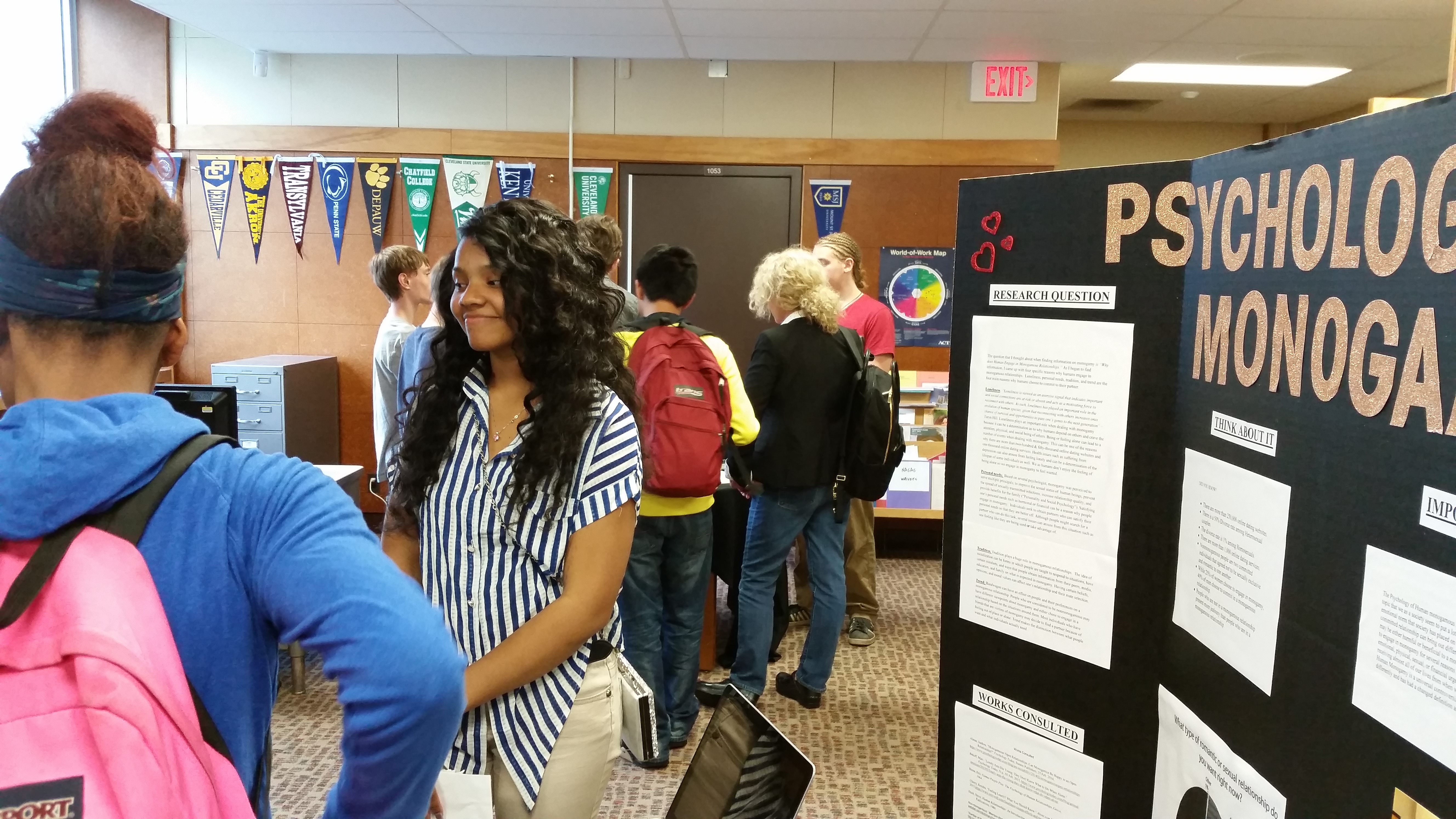
An exploration of the psychology of monogamy.
When I asked her in August of 2016 to describe a bit of her senior project experience, Mary’s response was effusive, more than a page and a half of single-spaced written commentary in a Word document. It was clear that it made a huge impact on her, and she was excited to talk about it.
Senior Project starts in the spring of the junior year, with students doing interest inventories and investigating questions in areas that spark their passions. They travel to the Cincinnati Public Library Main Branch and learn the basics of researching from the expert research librarians. While there, they locate several sources of information and start the process of reading the research and taking careful notes over the summer. The senior team provides support days periodically during that summer so students who are struggling can get back on the right path. Students have chosen a mind-bending range of topics, from fuel-efficient cars, prostitution in Cincinnati, animal welfare laws, and the existence of angels. Students must reach out to local experts in the field and find someone willing to mentor them, or at least to provide guidance showing that the student’s work was contributing to the larger conversation in that field.
The mentors have included the following:
Music Therapist from Melodic Connections
Attorney at Ohio Innocence Project
Chemical Dependency Counselor
African Drum Teacher
Children’s Transgender Clinic Social Worker
FBI Agent in Gang Task Force
Epidemiologist and former Peace Corps Volunteer in Africa
Local Activists from Black Lives Matter and other organizations
When the school year starts, the seniors’ schedule provides an additional bell that abuts their English and social studies bells but which is used primarily for senior project work. Mary explains the intense workload this way:
I personally spent so many hours on reading parts of books, whole books, articles, magazines, and blog posts. I also watched documentary after documentary. I watched every single one that was on Netflix (and there were surprisingly a lot) and then I watched more. I loved my topic so it was easy to waste away a lot of hours digging deeper into the subject. It is impossible to calculate how many hours I studied by myself but it was a lot. The classroom provided 5 hours of work time each week and that was every week for most of the entire year … It took me about 15 hours to put my video together after I got all of the footage. The footage happened on several different days and was then later combined into the final video at the end of the school year. Talking to my mentor took up a lot of time too. Basically, this project is very time consuming but that was expected and I enjoyed every moment of it.
Everything we do at Gamble should be aligned around creating this love of learning in a student. We set out to make a school that was safe for students – not just physically safe, but safe for them emotionally and educationally. This statement from a student expresses a sentiment that can never be measured on a standardized test. This is our Super Bowl win. I hear in there the joy of learning. I hear her talking of hours spent happily exploring a fascinating idea. The Socratic method of asking questions and digging ever deeper for answers drew her in, engaged her curiosity, and created a deep passion for a topic. Within that, we taught her the skills to follow future ideas that capture her attention. This is what every parent hopes for their child to experience at school – a passion for learning.
An in-depth look at making America’s favorite possession - our cars - even better.
How was senior project different from other work she had done in school?
I had to contact professionals and ask for help, I had to talk face to face with strangers, I learned how to take advice from constructive criticisms and not be offended, and I had to kindly and intellectually retaliate to people who were challenging my ideas. I think the most outstanding thing about senior project though, was that by the end I felt that it had made me a more confident, outgoing, and educated individual; and the best part was that I achieved all of that studying something I was passionate about.
Above are the words of scientific discourse, of intellectual engagement, the words of a person who is engaged in the pursuit of knowledge for the public good. To seek out ideas that challenge your current thinking is the heart of a strong and confident education. This is the “ready man” as described by Sir Francis Bacon and further explored by Samuel Johnson, who both assert that the “ready man” – the educated man ready to engage in leadership and intellectual discourse in his community – is made by conversation.
Challenges confront the students throughout the year. Occasionally a student will lose the passion for a topic, proclaiming it boring, or lose the thread of an argument. This often means they think they have run out of areas to research. Through a conference with his teachers, he will have to decide whether to revise the question, start over, or struggle through the roadblock. This is akin to a dead end in scientific inquiry, and the answer depends on the calendar and the individual. Is there time to start over? Is there any guarantee that the replacement question will prove more fruitful?
A student demonstrates how he modified his audio system.
The senior team of teachers provides academic support in classes with a curriculum that overlaps some of the same ideas that students are exploring. Students writing about race find readings in psychology class that work as evidence for their research. (On the playground at lunch, older students will inevitably respond to statements about a person’s race with the quote, “Race is a social construct!”) Additionally, standard research format is taught and reinforced. One of our 2016 graduates, Syirra Roberts, reported to me that her freshman psychology teacher pulled her aside after three weeks of class and asked which high school Syirra had attended. Her test scores and classroom responses revealed a deep understanding of the topics being discussed, and her professor asked her to pass on his respect to her high school psychology teacher.
In thinking about Mary’s zeal for her topic when she delivered her speech, one could argue she put up a good show for her final grade. Was that passion real? My conversation with her occurred more than a year after graduation. Students often will tell the “whole truth” after a year away, feeling no need to dissemble in order to get a good grade or not hurt someone’s feelings. I think the answer is this: Embedded among Mary’s responses was this invitation extended to me: “If you haven’t ventured into answering the questions you have about where your food comes from (or if you don’t have questions but don’t consider yourself to be someone who knows much about the food industry) I highly encourage you to do so. It is something that is so important and there are so many things that people don’t know that they should.” The passion is real. A year later, Mary has become an advocate for others to learn more about the food process.
I learned how to take advice … and not be offended, and I had to kindly and intellectually retaliate to people who were challenging my ideas.
This could just be an extended research paper, except for Senior Project Night. Each spring, mid-May, the seniors do not merely turn in the work to a teacher to anticipate a grade. Instead, they present their work to the community. Spread throughout the gym, library, and some adjacent classrooms, each senior commandeers a table and displays his or her work. There are required elements: a visual presentation showing what they learned, a research paper, a persuasive component, a spoken summary of their work along with the ability to respond to questions about their topic, and a service requirement. Students often display some of the reference material they cited, especially books they bought. Students are required to produce something that demonstrates a deeper understanding of what they have learned. Sometimes it is a pamphlet providing important information about their topic, or it is information about a dog the student adopted and nursed back to health at a local shelter or in their own home.
The seniors’ parents are present, as are their mentors. Nearly the entire faculty drops by, as do parents from past years, and parents of younger students who are curious about the event. Dozens of students, especially juniors, make a point of attending. These guests are invited to not only sign in at each table, but also to offer feedback; this feedback then helps form a portion of the student’s final assessment.
This brings us back to that night. Students in their formal clothes, young men pulling at their collars and adjusting their ties, young ladies in dresses too formal for the typical school day. All nervously walking through the rooms, gathering the last of their materials, moving tables into place, calling a favorite aunt to give last-minute parking advice. And then it is show time.
Our seniors present their work in charts and graphs, pamphlets, tri-fold boards and every conceivable format. One year a student dressed in a yellow haz-mat suit, emerging sweaty but proud at the end of the evening. Students bring old tires and photographs. There is music and laughter, and quiet discussions as adults are confronted with the difficult topics tackled by their children. These questions have included the following:
Why is it that exotic dance/neo-burlesque, which is one of the top forms of entertainment in the world, is looked at as a degrading and/or a morally reprehensible profession for the women working in it?
When should transgender children transition socially and physically?
How does a mother’s age, mental state and lifestyle choices while pregnant affect how a baby develops in the first 6-8 weeks of life?
Is the death penalty an ethical punishment that reflects society’s views?
Why is it that people are unfairly treated based on the stigma of HIV/Aids?
Is ISIS really following Islamic Ideology?
Why do humans feel the need to be in a monogamous relationship?
Mary’s final presentation table included a crock pot of vegetarian chili (which was delicious and indistinguishable from traditional meat chili), a video of her presenting her findings, and a second video of “man on the street interviews” in downtown Cincinnati.
That’s right, the same girl who stepped behind her mother when it was time to meet her potential new principal, had gained the confidence to stop strangers on the street, ask them questions about the food they ate, and to provide on-the-spot answers while being videotaped. And here, on Senior Project Night, she confidently answered questions from every person who approached her table.
There is a moment during each Senior Project Night where I find myself drawn away from the tables and the students. I stand silent at a distance in each place our students are presenting; first in the gym, then in the library, and then in the large classroom. I allow myself to examine the whole scene in front of me as one picture. I take a long, deep breath. In this hive of activity, I hold each student momentarily in my gaze. I remember their arrival as timid 7th graders, or perhaps as anxious and wary high schoolers. I reflect on their struggles, and I note that, without exception, this night is a victory for each of them. Tonight they display the work that has been for them the hardest thing they ever imagined doing. Many admit to not believing they could do it at all. Here they are, each of them. Beautiful, proud, accomplished. I stop to see them as they are in this moment, resplendent and triumphant.
I often call moments like these “the teacher’s real payday,” and these are enough to fill the soul.
Early in the 2013-2014 school year, my walkie-talkie crackled to life with an urgent call to a classroom. In the hall I passed a girl, new to our school, who was yelling threats and trying to break free from the grip of our security assistant. I could not immediately tell who she was threatening.
One of the adults who had been present in the hall when the incident started, Roberto A., started to tell me the story by expressing his amazement. “Jack, I’ve never seen anything like this in my entire life.” He related that the new student was convinced that someone was looking at her “wrong”. Offended, she stood up and started shouting at Michalia, a student who had been at Gamble since 7th grade. The shouting is what prompted him to enter the room and to call for me on the walkie. Michalia stood up and shouted back “I don’t have any beef with you.” As Roberto moved closer, the new student punched Michalia, who took one step back and said, “Somebody better get her. Somebody needs to tell her that’s not what we do here.”
“That’s not what we do here.” This is a most remarkable response to being punched. Many people would say that being hit would excuse Michalia if she chose to fight. I know that once upon a time, Michalia would have fought for less. I know that she felt immense social pressure to solve the problem by fighting, and that each year a small number of students make the other choice when in a similar situation. I also know that many times, parents defend and even encourage this response. That’s why her decision was hard.
Michalia resisted all of this, and accepted – trusted – that the adults in the school would act on her behalf and she did not need to fight. In doing this she was also showing tremendous grace toward her antagonist.
“Somebody better get her. Somebody needs to tell her that’s not what we do here.”
In 2010, money was tight in Cincinnati Public Schools. Principals were asked to take steps to save money by reducing our largest expense: cut back on staffing. I convened a meeting of the Instructional Leadership Team to examine the bleak prospects of eliminating parts of our music program in order to balance the budget.
Originally published May 16, 2016. Updated June 2, 2017.
In community, preparing for commencement.
It is commencement season, and our Facebook feeds and conversations with friends are filled with celebrations: hard-won degrees earned, and lifelong goals met. It is a joyous time of year.
Every commencement is special, but some years and in some locations, there is magic. In 2014 Gamble Montessori senior Michael Tucker reached a personal milestone as he crossed the stage and received his diploma. Michael was not just graduating from high school. He was confined to a wheelchair due to muscular dystrophy - or at least he had been. Though this was his situation during his entire time at Gamble, he had expressed to his teacher and mother that he wanted to walk across the stage at graduation. For more than a year, he regularly left school twice a week to get physical therapy that was at times painful for him, but he had a goal. He had knee surgery to extend his tendons so he could stand upright enough to walk, and he engaged in extensive recovery therapy. He even started walking to different places around the classroom, practicing the commencement walk tirelessly.
On commencement day, we had a lift available to get him on and off the stage. This was a precaution, in case fatigue or the excitement got in the way of his plans. At our rehearsal he stumbled a bit, but assured us through sign language and his determined look that he would be fine for the big event. That afternoon, when his name was called, he started confidently across the stage … and did exactly what he said he would, walking independently toward me to get his diploma. Michael’s mother reported that, behind her, another woman exclaimed loudly, “It’s a miracle!” Certainly it was. We were crying at the celebration of a goal visibly achieved through hard work and pain over an extended time. It was better than a miracle: it was a hard-won victory.
This celebration of personal and individual triumph is, of course, why we were crying and applauding for every child. For each graduate, the obstacles are very real, if not as dramatic or as visible.
Even in a ceremony lacking a miracle, commencement should be a required event on the teacher calendar. There is no more powerful reminder of the importance of a teacher’s work, and the value of our time spent in conversations with students about quality of work and matters of integrity and timeliness. I remind my students that this particular ceremony is an important gateway into society. Their diplomas, already earned, wield the real power to their post-secondary future. The ceremony, however, remains an emotional symbolic transition into adulthood.
Seated students Commencement 2017
The photos and stories in our Facebook feed reveal that, over time, every school develops its own traditions and ways of taking care of the important business of sending students out into the world. Some have mechanical, no-nonsense commencement ceremonies, appropriate especially for schools with large graduating classes, while others have developed odd traditions, like the Smith College Diploma Circle, where students are handed someone else’s diploma and seek their own in a method described here: http://www.smith.edu/events/commencement_traditions.php . Almost all feature a speech by a student in the class, a dignitary or two, and representatives of the Board that oversees the school. Many feature music by the school’s choir, band, or orchestra, perhaps performing the processional and/or recessional.
In the spring of 2010, Gamble Montessori, in just our fifth year of formal existence, celebrated our first commencement, and faced a bit of a challenge. The Board of Education provided an outline of required events in a certain sequence (pledge of allegiance, conferring of diplomas, etc.) but these were not a graduation ceremony in themselves. There was no personality there, no recognition of what made us unique. So we turned to ourselves –a graduation committee consisting of teachers, paraprofessionals, parents, students and myself – to create an event worthy of our students.
Even in a ceremony lacking a miracle, commencement should be a required event on the teacher calendar.
For our first commencement, Janice Dale, a paraprofessional who had worked with our students for years, and who our students intermittently addressed as Mrs. Dale and “Grandma,” offered a bold proposal: in addition to focusing on the achievements and development of the individuals, we would have a series of 3 commencements that would served to place Gamble appropriately in the timeline of public Montessori schools. Our school was the 7th public Montessori school in the Cincinnati Public Schools system, and the second high school. There is no public Montessori system like it anywhere in the world, but we often took it for granted. She wanted to give our faculty, students, and families a remarkable gift. She suggested we should honor those who made our school possible, in order to remind ourselves how we were special. More importantly, with Mrs. Dale’s help, we made sure that our commencement was a space for our students to celebrate their individual talents, whether it was reciting poetry, dancing, or singing.
[Author’s note: We followed her plan. Our first 3 years we honored: the beginnings of Montessori in Cincinnati including those who worked to create the first public Montessori elementary schools here, then the more recent past including those who broadened the number of Montessori elementary openings in Cincinnati, and finally we recognized those individuals who were directly responsible for the creation of Gamble Montessori 12 years after the opening of the first public Montessori high school, Clark Montessori.]
Commencement is best when the focus is a celebration of students’ talents and interests, and those define the ceremony to make it unique. It is crucial to honor the individual student, and to honor each and every individual. Just as a conscientious teacher builds choice into classwork and tailors assignments to match the strengths and interests of individual students, a conscientious administrator understands that to truly celebrate community, we must celebrate each of our individuals at commencement. We understand that when we share the responsibility and share the limelight, we make our community stronger. For this reason, students can be entrusted with several opportunities to make the ceremony theirs.:
Allow students to pick their student speaker, instead of having this determined by a GPA or by a committee. Many believe the valedictorian to be the student with the best grades at the completion of school, and that this person is required / entitled to give the main student speech at commencement. However, the accurate definition of valedictorian is less specific, simply the student chosen to give the main address at commencement. Rather than a formula or a committee deciding, our seniors choose this person internally. Often, as it was in 2017, students will choose the valedictorian, as this person has typically exemplified herself as a capable student who responds well to adversity and can be depended on to deliver a strong speech.
Allow seniors to invite to the keynote speaker of their choice. Given enough lead time, local politicians and activists, and even celebrities, are honored to be asked to speak at a commencement. Our students have historically chosen favorite teachers from their younger years at Gamble. This year they chose two current teachers to share the responsibility. In each case, they have selected teachers who were storytellers and who both loved and frustrated them.
Allow students to choose their graduation gown color from one of the school colors, instead of assigning them by gender. It creates an attractive and varied group picture, and avoids the discomfort and frustration that can come from mandating gown colors.
Have student videos featuring pictures and quotes, or even baby pictures. Another option is to have posters featuring seniors’ favorite photos of themselves. Finding a different way to honor the students, rather than merely having their name read aloud the moment they cross the stage, makes for a more engaging ceremony for the crowd of family members who might only know one of the graduates and will be pleased to see their familiar face in more than one place.
Allow students to choose which talented students will display their artistry at commencement. In five short years we have had singers, a praise dancer, and poetry readings. In 2017, our own band was able, for the first time, to perform Pomp and Circumstance.
Allow students the chance to - tastefully and within appropriate boundaries - decorate some part of their gown or mortarboard.
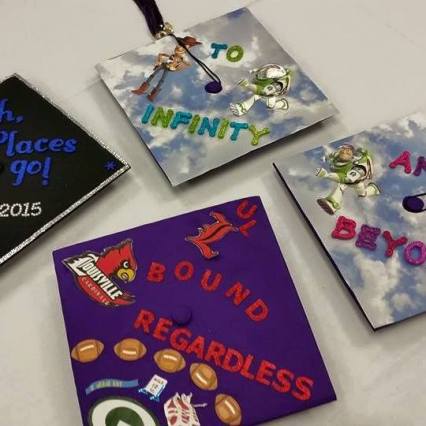
2015 Gamble Montessori Mortarboards celebrating the journey, the future, college, and life-long friendships!
In 2014 students asked if they could decorate their mortarboards, those flat-topped square hats that graduates wear. The traditionalists among us initially rejected the idea, but again, respect for the individual won out. We quickly created three simple rules for the mortarboard decoration and a new tradition was born: it had to be two-dimensional, it had to fit completely on the board, and it had to be school appropriate. What followed were dozens of decorations that compared their journey from kindergarten to commencement to a popular video game, touted their college choices and majors, and touchingly celebrated their friendships.
Certain parts of the ceremony have remained steadfastly the same, in place to make sure we honor each student individually. First, we remind our families early in the ceremony how important it is that we honor each student fully, but within the time provided. Many of our students have invited distant family relatives to this milestone ceremony, and they take the occasion of commencement to loudly exclaim their pride and love. Rather than suggest that it is not appropriate to applaud and cheer loudly (of course it is! This is a time of celebration!), we remind our parents that the child being introduced after their child is equally deserving of praise and applause. Then, as a cushion, we have built in a little extra time for each student. When a child’s name is called, she steps onto the stage to shake my hand, accept her diploma, get our picture taken together, and shake the hands of the Board member and other dignitaries. Rather than immediately calling the next name and being frustrated by continuing applause, we allow the student their full moment, only calling the next name when she reaches the top of the stairs to descend at the other side of the stage.
Gamble’s graduation has never been interrupted by cheering extending into another student’s introduction, or marred by silence as a graduate’s name was called and his small family’s applause was lost in the crowd and reaches of the conference center. Each year our families have honored every graduate, and demonstrated the sense of community we seek to instill in each of our students.
One year, the students asked Tara to sing a solo with the choir. She worked with the teacher to select the appropriate song, “Dare to Dream” by John Legend. Weeks of practice got her fully prepared, vocally, for commencement. Nothing had prepared her emotionally for singing in front of such a large crowd and – more importantly – singing to friends she was just starting to realize she might not ever see all together again. We cried with Tara as she stumbled through her solo, singing a prayer of hope as a gift to her classmates: “Hold on when hope is gone / Race may not belong to the swift or the strong / It’s given to the ones who can endure for long / I know we care.”
One year we laughed as teacher Jason Banks pulled the microphone free from the podium, jumped off the stage, and urged the graduates to leave their seats and sit Montessori-style in a circle on the floor. He reminded them of their marine biology study in Pigeon Key, Florida, and their whitewater rafting trip where they woke up to 4 inches of fresh snow. He prompted them with, “Always leave a place …” and they finished, “Better than you found it!” Then he read them key excerpts from Oh! The Places You’ll Go.
The best commencements are the ones where the crowd can feel just a little bit lost, but each student feels completely found.
Between our rehearsal and the actual ceremony, some time is carved out for students to be in community with one another. One year teacher Josh Vogt used the opportunity to read a short story to the seniors, one that challenged them to think about their relationships with one another an with the community. This year we used that time to open our gratitude box, filled over the past several years from various ceremonies around gratitude, and reflect on the people and circumstances that helped get us to this point. What is important is that you can take a minute to be, again, one last time, in community.
Each year, as we gather for graduation practice, I remind my students that commencement is an important ritual, yes, but also just a grand show. The hard work has been done. They have earned their diplomas with nights of hard work and days of concentration. They have raised and spent hundreds of dollars, and invested thousands of hours over 12 or more years of their lives. The big work of their lives so far has been completed, and everyone has gathered to honor them. They have earned this celebration, and we are so proud of them.
This is the time to pay close attention to each other, be patient, and be in love with the moment and with our students. We follow the child, hit our marks, and let the miracles happen.